If something is oxidized then its oxidation number goes up. Oxidation is the loss of electrons.
If something is reduced then its oxidation number goes down. Reduction is the gain of electrons.
There are many ways to remember this. Pick one and remember it forever.
OIL RIG. Oxidation Is Loss. Reduction Is Gain.
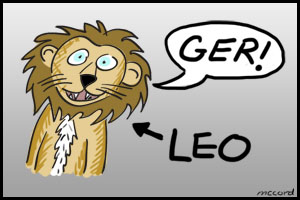
LEO says GER. Lose Electrons Oxidation. Gain Electrons Reduction.

For example, let's look at the reaction.
\[\rm{2Fe(s) + 3O_2(g) \rightarrow 2Fe_2O_3(s)}\]
In this example, the oxidation number of iron starts at zero and then goes to +3. The oxidation number of oxygen starts at zero and goes to -2. The iron is oxidized. The oxygen is reduced. Note: the name oxidation comes form the fact that reaction with oxygen leads to oxidation.
We can further put "names" on the compounds involved in the Redox reaction to identify their "actions". In this reaction, we would call oxygen the "oxidizing agent" since it is oxidizing the iron. The iron would be the "reducing agent" since it is reducing the oxygen. There is always oxidation with reduction, so we always have an oxidizing agent and a reducing agent. However, often in reactions we only identify one of them (the other is then identified by default).
Redox Agents
In the reaction CO + H2O --> CO2 + H2, what is being reduced?
(mouse over choices to get answer)
© 2013 mccord/vandenbout/labrake