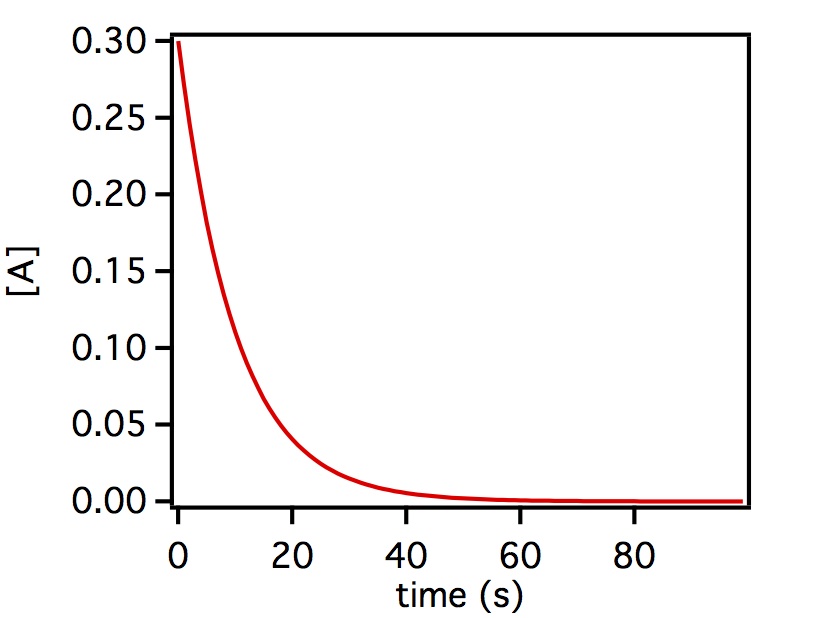
Since the concentration is decaying exponentially for a first order reaction, then the natural log of the concentration will decay linearly.
\[[{\rm A}](t) = [{\rm A}]_0e^{-kt}\]
taking the natural log of both sides you get
\[\ln[{\rm A}] = \ln[{\rm A}]_0 - kt\]
This means a plot of the ln[A] vs time will yield a straight line with a slope of -k and and intercept of ln[A]0
On a linear scale the decay will look like this
The natural log plot will look like this
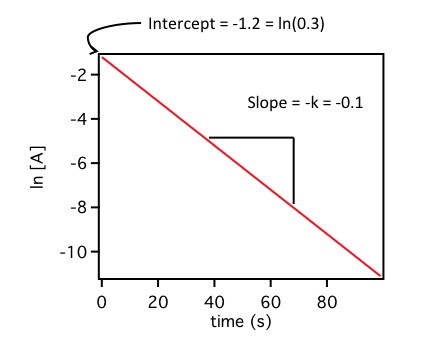
The decay is not a straight line (perfect in this case since it is just simulated data without any noise). The intercept is ln[A]0 = -1.2 (since [A]0 = 0.3, ln(0.3) = -1.2). The slope of the line is -0.1 so k is found to be +0.1 s-1.
© 2013 mccord/vandenbout/labrake