How does the vapor pressure change with temperature? We would expect it to get larger as the temperature is raised. Why? As T increases we start to favor the higher entropy state. That is the gas phase. Let’s look at some data to see what happens to the vapor pressure of water as the temperature changes.
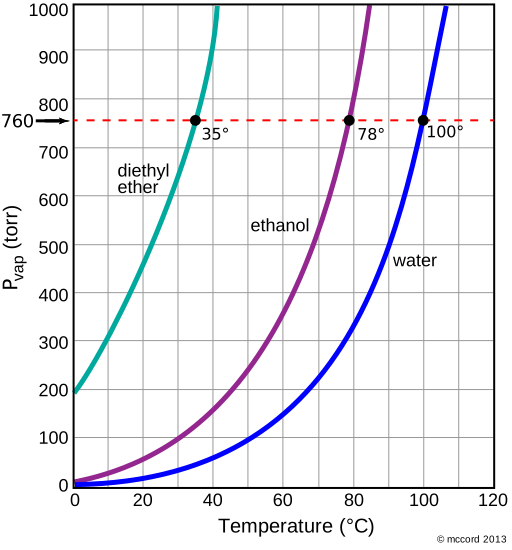
This figure shows the vapor pressure of water, ethanol, and diethyl ether as a function of temperature. Note the exponential function of temperature. The strongest IMF in water leads to the lowest vapor pressure at each temperature.
Using our ideas of free energy, we can develop an equation that quantifies this temperature dependence. Again we are using our "thinking like a chemist" approach to try to relate macroscopic measurable quantities (the vapor pressure and temperature) to microscopic molecular ideas (the free energy).
What are we looking at? A liquid in equilibrium with its vapor at a pressure P at a temperature T. When the system is at equilibrium the two phases have the same free energy. Thus we can say at this temperature and pressure
\[\Delta G_{\rm vap}=G_{\rm gas} -G_{\rm liq} = 0\]
The free energy of the liquid is approximately independent of the pressure, thus the free energy at pressure \(P\) is about the same as that at the standard pressure (the one with the zero superscript). Thus we get
\[G_{\rm liq} = G_{\rm liq}^\circ\]
However, the free energy of a gas depends strongly on the pressure (as do essentially all the properties of a gas). The free energy of a gas is given by the following relation
\[G_{\rm gas}(P) = G^\circ_{\rm gas} + RT\ln \left({P\over P^\circ}\right) = G^\circ_{\rm gas} + RT\ln (P)\]
where we drop the \(P^\circ\) term as long as we use \(P^\circ = 1\) atm. Then that ratio is just the value of \(P\) in atm. Putting this all together we find
\[\Delta G_{\rm vap} = G_{\rm gas}(P) - G^\circ_{\rm liq} = G^\circ_{\rm gas} + RT\ln (P) - G^\circ_{\rm liq}\]
\[0 = \Delta G^\circ_{\rm vap} + RT\ln (P)\]
\[\Delta G^\circ_{\rm vap} = -RT\ln (P) \]
Thus the vapor pressure depends on the standard free energy of vaporization.
\[\Delta G^\circ_{\rm vap} =\Delta H^\circ_{\rm vap} -T\Delta S^\circ_{\rm vap}\]
rearranging these gives
\[\ln(P) = {-\Delta G^\circ_{\rm vap} \over RT} = {-\Delta H^\circ_{\rm vap} \over RT} +{\Delta S^\circ_{\rm vap} \over R}\]
If we take \(\Delta H^\circ_{\rm vap} and \Delta S^\circ_{\rm vap}\) to be independent of temperature, then the only temperature dependent term in this equation is the one with the enthalpy change. Thus we see that temperature dependence of the vapor pressure depends on the enthalpy of vaporization. Remember the enthalpy term is the energy term. This is the one which relates the difference in potential energy in the liquid state to the potential energy in the gas state and is essentially the IMFs.
Rearranging the last equation we get
\[ P = K e^{-\Delta H^\circ_{\rm vap} / RT}\]
K is the vapor pressure in the limit of infinite temperature. At finite temperature the vapor pressure is lower by an exponential factor of the ratio of the enthalpy of vaporization compared with R times the temperature.
The final conclusion! The vapor pressure increases dramatically with temperature.
© 2013 mccord/vandenbout/labrake